
The origins — 18th and 19th centuries
The first sloops appeared during the colonial era to meet a simple need: to travel quickly from one island to another. Transporting goods, fishing, inter-island trade, and passenger transport—everything relied on sail, as airplanes were still unavailable. The islands were close, but the currents were strong and the wind constant. Fast, sturdy boats capable of sailing upwind were essential. Local shipwrights developed a type of sailboat perfectly optimized for these conditions.
An influence from the North
In the 19th century, whalers from Nantucket and New Bedford frequented the region. They brought with them the hull shapes of their whaleboats and shipbuilding techniques. The shipwrights of Bequia adopted these techniques and adapted them to build larger, more seaworthy boats. From this fusion, the sloops of the Grenadines were born.
Technical specifications
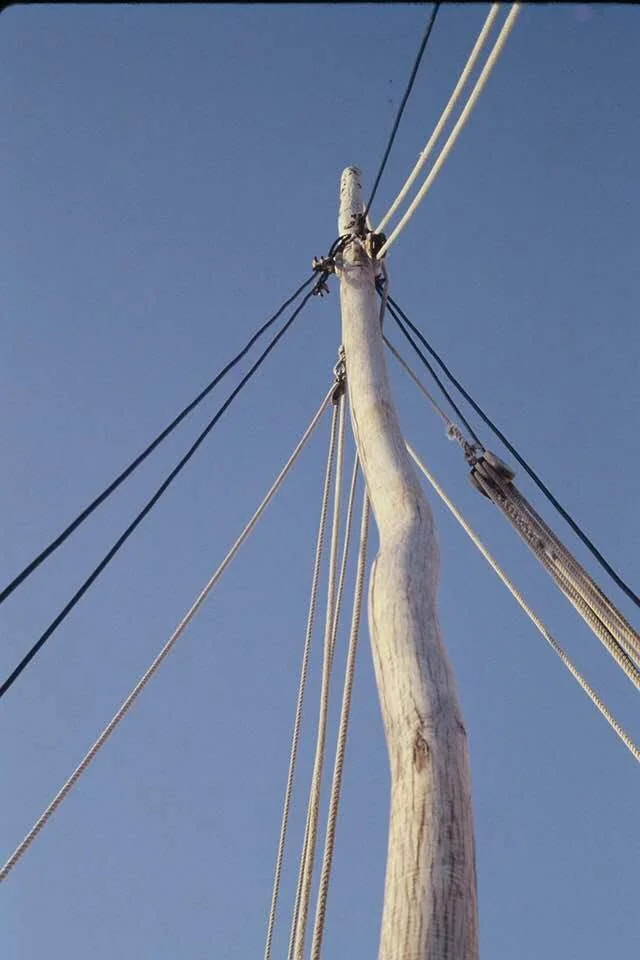
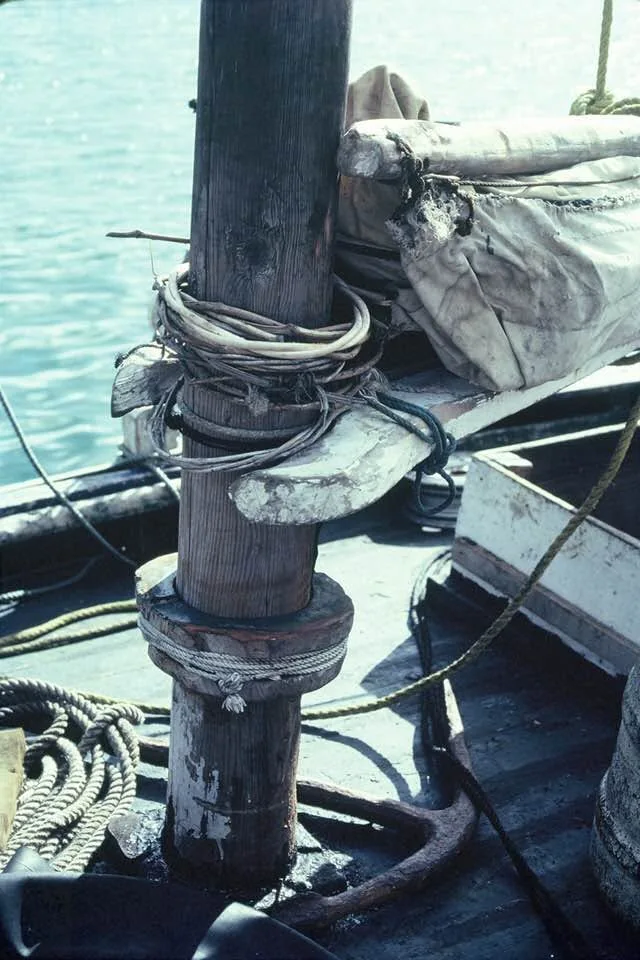
Wooden-planked hull on frames, fine bow, sloping transom. A length of 8 to 15 meters, with a generous beam for stability. A sloop rig—a single mast—and a large triangular mainsail, sometimes accompanied by a jib or staysail. These boats are renowned for their speed, their ability to sail upwind, and their robustness in the short but sometimes choppy seas of the Caribbean.
Traditional construction
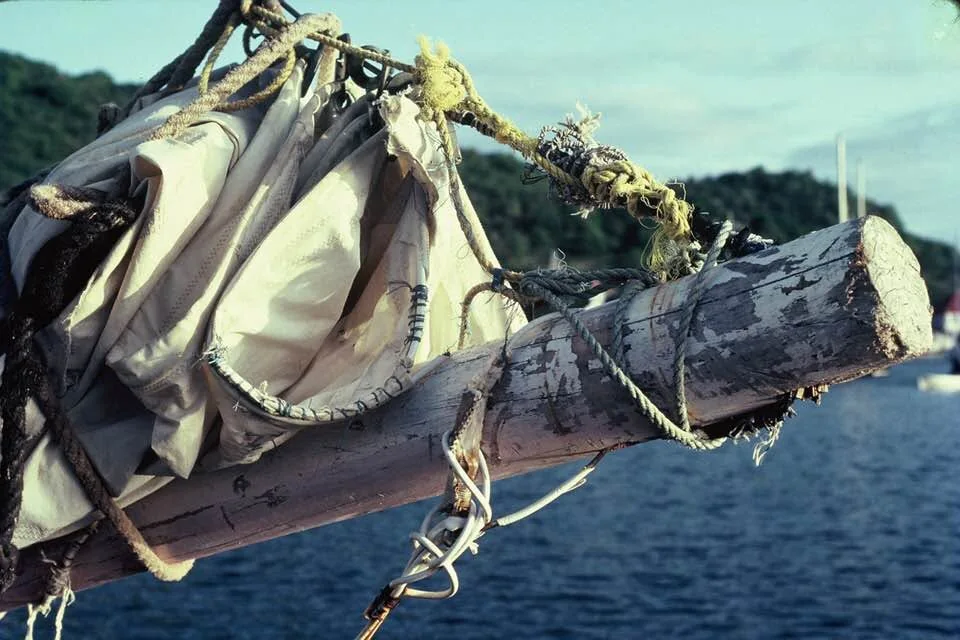
Everything is done by hand: fitting the curved frames, laying the planks one by one, caulking between the planks with cotton and tar, casting the iron keel, and then rigging. Most often, no plans are written down. The shapes are memorized, passed down from one shipwright to another, and corrected by eye.
The Golden Age, 1900-1950
At the beginning of the 20th century, sloops completely dominated local maritime transport because they were smaller and cheaper than the large sailing ships from Europe that made the transatlantic crossing. They carried essential goods such as charcoal, cotton, sugar, fruits and vegetables, animals, tools, and passengers… Each island then had several dozen sloops in operation.
Grenadines sloop or Carriacou sloop?
The two are often confused. They belong to the same tradition, but have diverged depending on the island.
The Grenadines sloop, Bequia type. Historically, it was a transport and coastal trading vessel: wide hull, large cargo volume, pronounced stern, moderate draft. Stable and robust, it was designed to carry freight, not just to travel fast.
The sloop of Carriacou and Petite Martinique took the other path: a longer, narrower hull, a very fine bow, a deeper draft, and an immense sail area. Much faster, excellent upwind, but more demanding at the helm. They are, in their own way, speed machines.
Cultural heritage of Saint-Barthélemy?
Like all islands, Saint Barthélemy depends for its survival on supplies brought by these ships—even more so than others, because it is a tiny island, where rainfall is very low, where there are no natural water sources, and where almost nothing grows, except for a few goats. But Saint Barthélemy has one advantage: it is a free port, meaning that goods are exempt from taxes and are not inspected. Everything can therefore pass through legally, at least from the island's perspective.
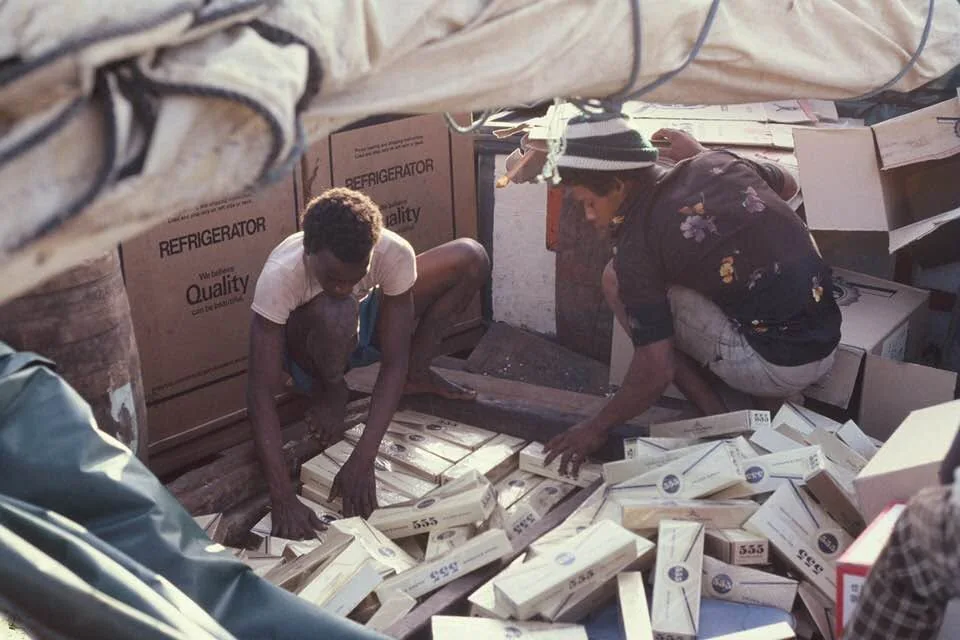
The sloops then found an even more lucrative market: the smuggling of rum and cigarettes. These goods were legally purchased in Saint-Barthélemy, then unloaded at night on the beaches of the other islands and resold on the black market.
It is precisely in this game of cat and mouse with the neighboring authorities that the sloops of Carriacou distinguish themselves by their speed: they easily outrun the customs sailboats that try to board them.
This trade would become the primary source of prosperity for Saint-Barthélemy and would make Gustavia a stronghold in the eastern Caribbean.
In the 1950s, the island's prosperity, and indeed its survival, depended primarily on the boats built in Carriacou. This is what links these two islands within a shared cultural heritage.
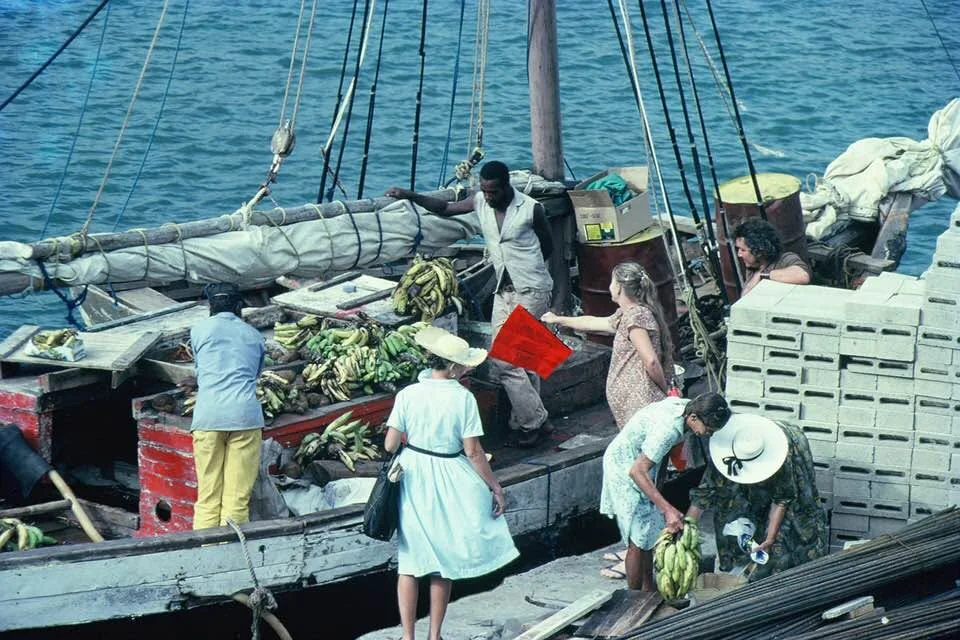
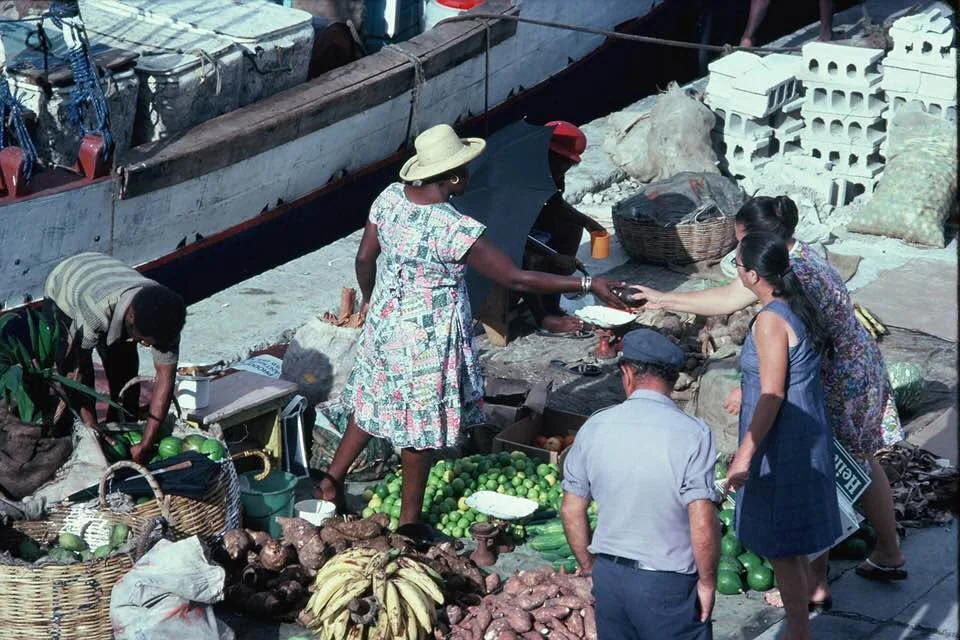
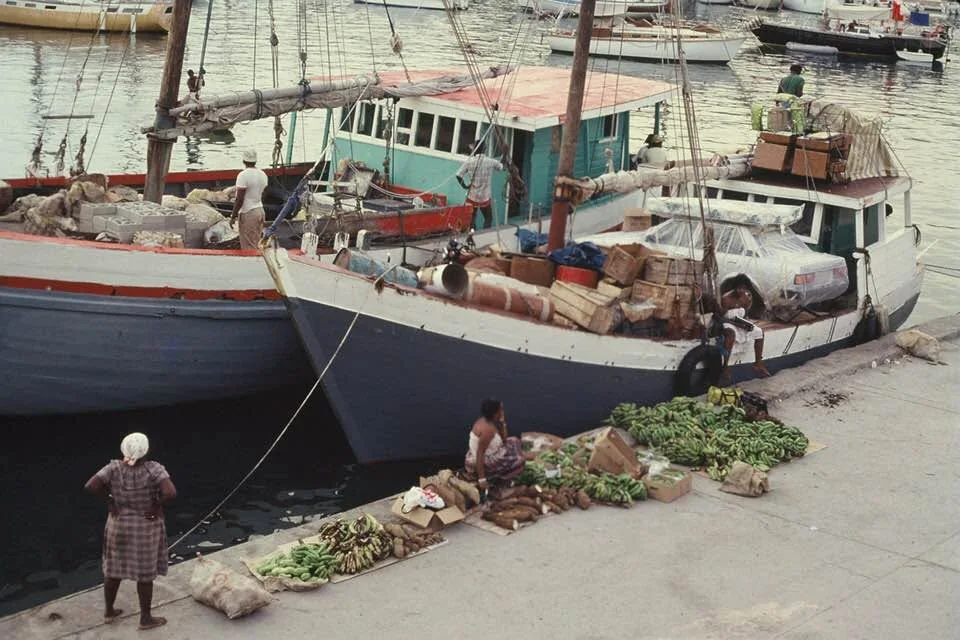
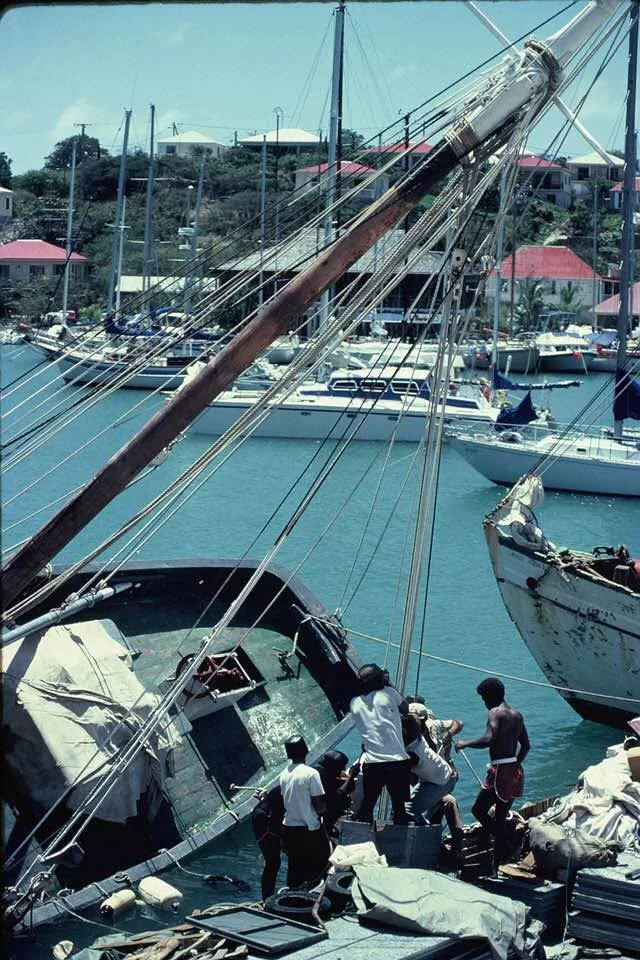
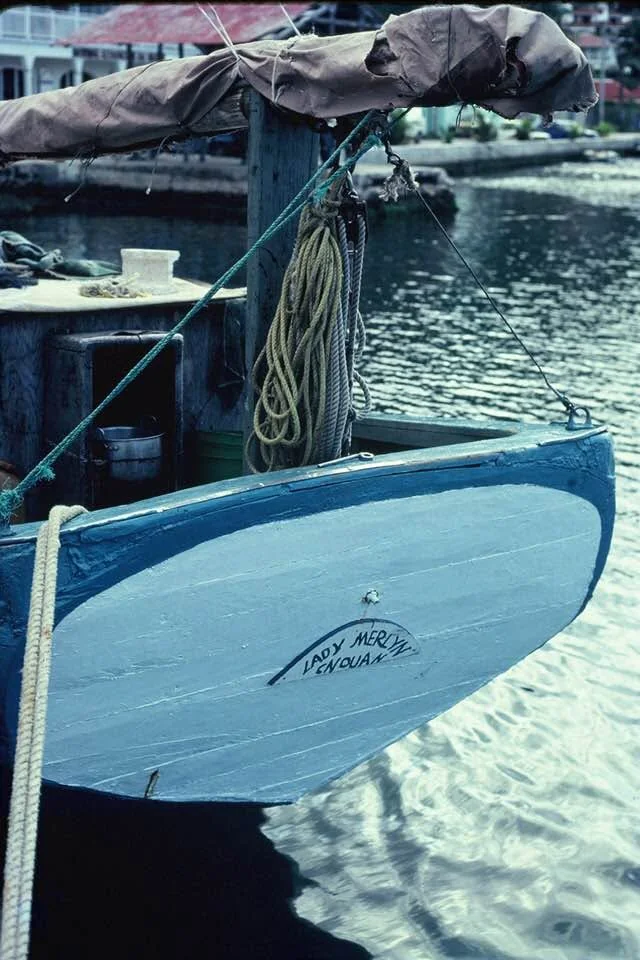
The decline of sloops, starting in the 1960s
Outboard motors, modern cargo ships, and fiberglass rendered them obsolete within a generation. Many boats were abandoned, others converted into fishing vessels.
The rebirth through regatta
It is the traditional regattas that keep the sloops alive: the Carriacou Regatta Festival, the Classic Regatta of Antigua, and the West Indies Regatta Festival of St. Barthélemy. It is there, and almost only there, that these wooden boats continue to race, and it is also partly for these regattas that they continue to be built—in Carriacou rather than Bequia.
Bequia: The end of the big ships
In Bequia, traditional shipbuilding of large vessels no longer exists. The construction of small fishing boats by Orbin Ollivierre and miniature boats by the Sargeant Brothers still remain. Launched in 1980, the Water Pearl was the last large boat built in the island's shipyards. It sank four years later off the coast of Panama.
Carriacou and Petite Martinique: the last masters
Further south in the Grenadines, orders continue: for speed in regattas, but also for fishing and, increasingly, for charter — with the explosion of tourism, their traditional and colorful appearance gives them a very special charm.
In Carriacou, Alexis Andrews — future founder of the West Indies Regatta — commissioned the sloop Genesis from master shipwright Alwyn Enoe in 2005, and took the opportunity to write two books on construction methods.
In Petite Martinique, Baldwin DeRoche, known as "Balo", launched the sloop Savvy in 2007, then Beauty of Petite Martinique in November 2008, his last and largest boat.
In 2009, Alexis and a group of friends created the West Indies Regatta, initially for fun, with the idea of promoting these boats and reconnecting the island with traditional sailing. Inspired by this momentum, Thierry de Badereau financed the sloop Free In St Barth, launched by Alwyn Enoe in 2015.
The renewal
By filming the construction of the sloop Exodus, Alexis Andrews created the documentary film Vanishing Sail, released in 2015, with the aim of inspiring future generations. In 2023, drawing in particular on this footage and the support of the Grenadian government, the shipbuilding expertise of Carriacou and Petite Martinique was inscribed by UNESCO on the Representative List of the Intangible Cultural Heritage of Humanity—as a skill to be safeguarded.
Following the devastation wrought by Hurricane Beryl in July 2024, Grenada announced the creation of a Boat Building School. A site was chosen in Windward, on the island of Carriacou. A local entrepreneur, Piero Zipoli, initially financed a roof to shelter the shipyard, then a brand-new boat, under construction from the summer of 2025, which was expected to be launched in early 2027. In January 2026, the access road leading to the future school was inaugurated. Read his profile: Piero Zipoli.
The future?
Piero Zipoli has already secured an order from the Grenadian government for three additional boats. He plans to exhibit the first one at European boat shows to generate public interest and secure further sales.
Vincent would like to bring together the traditional regattas of the West Indies — starting with the Carriacou Regatta Festival and the West Indies Regatta Festival, but also the Classic Regatta of Antigua, and why not others, in the British Virgin Islands or Barbados — in order to better promote them and seek additional financial resources to help the owners of the Carriacou sloops who would participate in them.
Vincent and Piero both dream of a Caribbean where each island would have its own classic regatta, and where international sponsors would find it beneficial in terms of visibility as well as a cultural gesture.
This census, undertaken after the 2026 meeting between the organizers of the two regattas (Carriacou and St. Barth), is the first of its kind. More than thirty Carriacou sloops are included to date!
This list is incomplete, and will remain so as long as the memory of these boats lives primarily in people's minds. Any information that could complete or correct it is welcome—a launch date, the name of a shipwright, a photograph, a home port, the name of an owner…
From oldest to newest. Each boat has its own profile.
Status :  in service 23
  shipwrecks 9
  under construction 1 ❓ Not found 15
Those clearly identified.
- 1965PlumbellyBequia29 feet · Klaus Alvermann and Loren Dewar · two circumnavigations, present in 2009 at the first edition
- 1968Mermaid of Carriacou44 feet · Zepherine McLaren · the founding boat of the Carriacou Regatta
- 1969The Friendship Rose100 feet · Calvin Lewis and the Addams Brothers · last schooner of Bequia built with hand tools
- 1969Scaramouche80-foot Carriacou trading schooner · Martin Jennett · based in Union Island
- 1978Tradition50 feet · Carriacou · today chartering in Anguilla
- 1979GlacierPatrice family · Windward, Carriacou · expanded in 2010
- 1981Alexander Hamiltonschooner · Ralph Harris · last schooner built on the beach at Nevis
- 1984Good Expectation38 feet · Zepherine McLaren · cargo ship restored by Jus' Sail · Saint Lucia
- 1984Summer Wind37 feet · Alwyn Enoe · the boat that inspired Alexis Andrews' love of Carriacou sloops · Newport, Rhode Island
- 1986Sweetheart36 feet · Zepherine McLaren · Antigua
- 1986Laser58 feet · Alwyn Enoe · for sale
- 1998Summer Cloud39 feet · Baldwin DeRoche, known as "Balo" · Barbados
- 2002Jambalaya73 feet · Alwyn Enoe, based on a model by Jassie Compton · Carriacou's largest unit
- 2005Genesis42 feet · Alwyn Enoe · Alexis Andrews' boat, the origin of the West Indies Regatta
- 2007SavvyLittle Martinique43 feet · Baldwin DeRoche, known as "Balo" · Grenade
- 2007Windward Pride42 feet · Anthony McLawrence, aka "Nero" · ex-American Eagle · still racing the Carriacou Regatta
- 2008Beauty of Petite Martinique48.5 feet · The last one of Baldwin DeRoche, known as "Balo" · Saint-Vincent · The last one of Petite Martinique
- 2008Navasana40 feet · Alwyn Enoe · ex-Ocean Nomad, bow sculpted by Aragorn
- 2010New Moon32 feet · Bernard Compton · training boat in Antigua
- 2010Spirit of Zemi42 feet · based on Alwyn Enoe's designs · ex-Zemi
- 2013Exodus42 feet · Alwyn Enoe · the boat from the film Vanishing Sail
- 2015Free in St. Barth42 feet · Callistus Enoe · his first boat
- 2019Margeta36 feet · Calvert Compton · Carriacou
- 2027Windjammer46 feet · Callistus Enoe · under construction, launch planned for early 2027
Outside the Grenadines. A boat built elsewhere, but according to the same idea.
- Spirit of St. Maarten114-foot schooner built by hand in a village in Brazil, according to the same idea: it takes a whole village to make a boat.
Destroyed by Beryl. The hurricane of July 2024 sank several sloops from Carriacou.
- 1975Pink Ladyex-Super Mac · 37 feet · Ellis McLawrence · Palm Island
- Marie StellaMichael Bethel · winner in 2004 · Carriacou
- Power PlayBenson «Power» Patrice · Windward, Carriacou
- MV ResolutionNorman McLawrence and Roberts Carriacou
- 2020Reality 22020 · 65 feet · Anthony McLawrence aka "Nero" · cargo ship, Carriacou
- Deep VisionFrank Allard · large decked sloop · 2nd in 2011 · not repaired
Still to be found. These boats exist — or once existed — but information is missing: date, builder, home port, current owners. Sometimes, we don't even know if they are still afloat.
- Agatha D80 feet · Alwyn Enoe · his longest boat
- Lady IrisCompton family
- Lady Nadrina1972 · 32 feet · Alwyn Enoe
- Love RosesBenson "Power" Patrice · winner in 2019
- Misty Blue58 feet · Alwyn Enoe
- MonalisaAnthony McLawrence aka «Nero»
- One Droplarge decked sloop · 3rd in its class in 2013
- Pipe Dream40 feet · Gordon Patrice · 4th in Saint-Barth in 2011
- PM Gracebought and rebuilt by Anthony McLawrence, known as "Nero"«
- Power SurgeBenson "Power" Patrice · 3rd at Hillsborough in 2023
- Rosealyna P28 feet · Peter Patrice · small decked sloop
- Run Awaysmall decked sloop · Hubert McLawrence · 2008 to 2019
- Sea Fortresscargo boat · built in L'Esterre, Carriacou
- Starlight VMail schooner · Boyie Stiell · L'Esterre, 1960s
- Unity1980s · Anthony McLawrence's first boat, nicknamed "Nero"«
- Vilite Mariabought and rebuilt by Anthony McLawrence, known as "Nero"«
- Phiabiana Corion76 feet · Alwyn Enoe · built for Popo Corion, abandoned