
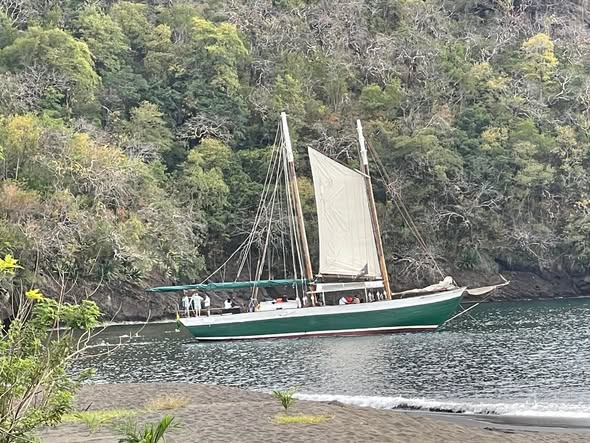
- Boat type — a two-masted wooden schooner, gaff-rigged, built for trade between the islands
- Original name — Sacred Dove
- Built — in Carriacou, in 1969 according to the Caribbean Compass; launched in 1970 according to Martin Jennett
- Built for — two brothers associated with a third partner; the names of the carpenters remain to be found
- Dimensions — 25 meters overall (80 feet including bowsprit) · 6 meters wide · 2.40-meter draft · 54 tons · 60-foot masts above deck
- Materials — frames of cedar hewn with an adze, keel of greenheart, Grenada and Carriacou wood, planking of Canadian pitch pine; after Ivan, frames replaced with manchineel and white cedar
- Owner — Martin Jennett, since 1979 · Captain in 2015: Barry
- Rebuilt — in Tyrell Bay, Carriacou, in 54 days, after Hurricane Ivan in September 2004
- In Saint-Barthélemy — West Indies Regatta 2012 and 2014 · «Queen of the Fleet» in 2012
- Home port — Union Island, Saint Vincent and the Grenadines
- Today — in service, day trips to Mayreau and the Tobago Cays
The country schooners
In the 1970s, about twenty working schooners, the "country schooners," still transported all sorts of goods between the islands. Some could carry up to 100 tons. In 1974, Grenada, having gained its independence, imposed a 100-ton tax on imports to boost its own production. But Carriacou and Union, nearly depleted of resources, could not feed themselves, and smuggling sometimes became the only way to survive. These boats were inexpensive to build: Martin Jennett recalls that if one sank, they simply built another. One after another, the schooners disappeared, sunk, abandoned, or motorized.
1969: a merchant schooner born in Carriacou
Scaramouche was built in 1969 in Carriacou to transport goods from island to island. For the frames, the shipwrights scoured the woods for cedar branches whose curve already matched the hull's shape. They roughed them out with an adze, then fixed them to a greenheart keel. The frame was made of wood from Grenada and Carriacou; the planking, of pitch pine imported from Canada.
Overall, including the bowsprit, the schooner measures 80 feet and has a tonnage of 54. Below deck, the cedar frames remain visible. In 2012, journalist Stephen Sammons compared the interior to a Tudor-era pub: warm, cozy, and fragrant with old wood.
Hundreds of wooden merchant schooners once sailed the Caribbean. By 2012, the Caribbean Compass listed only two: Scaramouche, from Union Island, and the schooner from Bequia. The Friendship Rose.
Like most country schooners, it was built on a beach near its owners' house, in a spot where there were few trees to cut down. The owners were two brothers, in partnership with a third. The boat was then called Sacred Dove and, according to Martin Jennett, it was launched in 1970. The partners had a falling out and abandoned everything: by 1975, Sacred Dove was nothing but a wreck.
The following is based on what is said in Union, without being verified: for the inhabitants, this boat was cursed, and they discouraged those who wanted to buy it.
A Scotsman in Union Island
Martin Jennett is Scottish. He left Glasgow in the mid-1970s, with no other plan than to find a passage to a tropical beach. "Luck is what brought me to The Grenadines," he sums up: it was chance that led him to the Grenadines.
On Union Island, where he arrived after abandoning his architecture studies, Martin Jennett met Jean Marzo, a French-Italian pied-noir and one of the pioneers of chartering in the Grenadines. Martin started by cleaning decks, then became a skipper. Business was booming, and the two men were looking for a new sailboat.
In 1976, they bought the wreck of the Sacred Dove. A year of restoration followed; the current masts, made of imported pine, were crafted to resemble the originals. Jean Marzo then moved to Martinique and handed the helm over to Martin. It was also he who taught Martin French, by playing him Brassens' songs.
A year after the boat was relaunched, Jean asked Martin how much money he had saved. Martin had $6,000; Jean offered to exchange it for his shares. In 1979, at the age of 24, Martin Jennett became the owner of the boat. He renamed it Scaramouche, a word he'd heard in Bohemian Rhapsody, Queen's hit song of the moment. The name sounded good, with a slight pirate vibe.
From trade to charter
Between 1980 and 2000, chartering experienced its golden age, and it was the only activity that allowed a schooner to remain afloat. Scaramouche was fitted out for passengers. Martin knew the business and secured contracts for day trips: the schooner carried up to sixty people a day. For the first few seasons, he worked with European skippers. In the late 1980s, in accordance with the regulations of Saint Vincent and the Grenadines, he hired local sailors.
Union has approximately 2,500 inhabitants, nearly 60% unemployment, and relies primarily on remittances from the diaspora living in Canada and the United States. Scaramouche's operations are a significant part of the island's economy.
Pirates, cameras, and a billionaire
In 2003, for the filming of Pirates of the Caribbean, In Disney's version, Scaramouche becomes a Portuguese merchant ship, with locals from the archipelago's smaller islands appearing as extras. The BBC also filmed her for an adventure series, and she has starred in several television commercials. She has served as a backdrop for fashion shows and live performances.
It is also said in the islands, without being verified, that Scaramouche is the most photographed boat in the Grenadines.
Its black mainsail came from a Russian billionaire. For his six and eight-year-old children, he had organized a pirate treasure hunt across the Caribbean, chartered several boats and had the sail painted black.
2004: Ivan and the Reef
On September 7, 2004, Hurricane Ivan approached the Grenadines. Sailboats sought shelter in the mangroves of Carriacou and Grenada. Too large to fit through, Scaramouche remained in the Clifton lagoon, moored to a buoy weighing approximately one ton, while a diver reinforced the anchor. However, a crew member misunderstood the mooring instructions, and by evening, with gusts already reaching 50 knots, no one could go to check.
During the night, winds exceeded 90 knots according to Voiles et Voiliers magazine, and 130 miles per hour according to the Caribbean Compass. From his house overlooking the bay, Martin watched the schooner chase the storm, powerless to intervene. In Grenada, Ivan caused 39 deaths and destroyed 90 houses; Union escaped without casualties, though roofs were torn off, poles were downed, and boats were washed ashore.
Early the next morning, Martin found Scaramouche on the reef, about a hundred meters from her mooring, lying at a 45° angle. Her frames had pierced the hull and her starboard side was ripped open. Sand carried by the rising tide held her captive.
The rescue
Bringing a tugboat and a 100-ton crane barge from Trinidad would have cost more than ten times the boat's value. Jerry, a friend who owns a tugboat, anchors right behind the schooner and turns his 5-meter diameter propeller: the sand is driven away, and the depth increases from one to four meters. For a boat with a draft of 2.40 meters, hope is rekindled.
It then had to be floated to be hauled onto the beach. The team removed the lead ballast and the engine, but the waterlogged planks sank. Two days later, with 80 empty 200-liter drums attached to the remaining frames, Scaramouche finally floated, its hull ripped open over 40 square meters.
Guy Charvat, a specialist in wooden boats and an insurance expert, is swamped with cases after Ivan. Seeing all these men working, he gets involved. Hauling the schooner would risk tearing the entire structure apart; he advises laying it on its side instead. Scaramouche is towed out of the lagoon, in more than 20 meters of water, and 700 kilos are attached to the tops of the masts to tip it over.
That day, about forty locals arrived by speedboat with Martin. They dove into the water, climbed onto the overturned hull, and, using chainsaws, nails, sledgehammers, planks, and plywood, patched it up so it could reach a shipyard without sinking. It was done in a few days. Among them were the crew and all those who had been sailing Scaramouche for years.
To right her, two fishing boats pulled, one on the keel, the other on the two masts. The maneuver went wrong: the masts broke, the bowsprit came loose, the rigging and part of the bulwarks were torn away, and the hull was riddled with new holes. Martin says he wept with frustration and grief. The team retrieved the masts, installed bilge pumps, and the schooner was towed ten miles to Tyrell Bay, southwest of Carriacou, the island where she was built.
The return to Carriacou
At Tyrell Bay, Scaramouche was hoisted onto the slipway. The old carpenters of Carriacou and their children also refused to let her die. True to tradition, they went to the neighboring islands to find local timbers, manchineel and white cedar, and rebuilt about thirty frames as well as the stern. Fifty-four days later, the schooner was relaunched. No traditional ceremony this time, but a little rum poured over the new wood.
May 2012: a shipment to Gustavia
On March 17, 2012, the West Indies Regatta announced the arrival of Scaramouche, presented as one of only two original cargo schooners still operating in the Grenadines.
On May 1st, at dawn, the schooner left Union Island. In the hold: several hundred fresh coconuts loaded at Chateaubelair, on the leeward coast of Saint Vincent, honey from Bequia, chocolate and cocoa balls from Grenada, rum from Saint Vincent—enough to supply the island markets during the regatta. The crew included longtime friends from Union Island, Saint Vincent, England, and France.
Once out of the Soufrière shelter, Scaramouche sped due north at over eight knots, sails trimmed like a racing yacht, under the moonlight. The 350 miles to Saint-Barth were covered in two days.
At dawn, Alexis Andrews, founder of the regatta, guides the fleet to the main quay of Gustavia aboard the sloop Genesis.
Scaramouche is given a place of honor opposite the Harbour Master's Office, next to the famous American schooner Ticonderoga. Bruno Magras, President of the Collectivity, and Daniel Blanchard, from the UNESCO Club, a partner of the regatta, come aboard. On Friday, the welcoming party is held on the schooner's deck. Mr. Ollivierre, from Bequia, opens more coconuts than anyone else and asks to be left in Saint-Barth when Scaramouche departs.
In the rankings, Scaramouche receives the title of "Queen of the Fleet".
Stephen Sammons recalls that in the past, a schooner like Scaramouche would have returned laden with duty-free goods, without giving customs much thought. This time, the crew says they respect the work of the customs officers, while hoping they will forgive the oversight of leaving behind a case or two of good French wine.
2014: Two schooners in Gustavia
Scaramouche returns to Saint Barthélemy for the sixth West Indies Regatta, from May 1st to 4th, 2014. Nine traditional boats are at the starting line. Alongside the Carriacou sloops, two schooners: Scaramouche, from Union Island, and the’Alexander Hamilton.
The organizers then announced that they would invite the only other original merchant schooner still in operation the following year., The Friendship Rose.
January 2015: A day on board
From Union Island, Scaramouche takes its passengers on day trips: breakfast, lunch prepared by the ship's cook, homemade punch, masks and snorkels for swimming above the reef. In 2012, Stephen Sammons recounted that a Swiss passenger returned six years in a row.
In January 2015, the schooner left Clifton at 9 a.m. with a Union crew. There was no windlass: the anchor was raised manually, and the hawsehole bore the marks of thousands of cable passages. They set course for Mayreau, the Tobago Cays and their turtles, then Palm Island, at 8 knots with all sails set. They returned to Clifton in the late afternoon, under the command of Captain Barry.
Seaman Rawlty has been on board for twenty-five years. He came aboard at fourteen, when his uncle asked Martin for a place for him. He is a full-time employee, a rare thing at Union.
Days with sixty passengers are a distant memory: faced with competition, the schooner takes on ten to fifteen, and at least six are needed for a trip to be profitable. Martin carries on nonetheless. He has never married; his life is consumed by the boat; of Scaramouche, he says: "She saved me, I owe her everything.".
Voiles et Voiliers notes that at Caribbean regattas, including Saint-Barth, it sometimes steals the show from the yachts by escorting them to the starting line.
What remains to be found
The names of the shipwrights who built Scaramouche, those of its first three owners, the beach where it was built, the exact year of its construction (1969 or 1970), its trade routes, and the date of its relaunch after Ivan. If you know any part of this story, please write to us.
Sources
- Tradition’s Alive Aboard Scaramouche, Stephen Sammons, Caribbean Compass, June 2012, p. 15 — the construction, Ivan, the reconstruction in Carriacou, the May 2012 trip to Saint-Barth.
- The ‘Wet’ Indies Regatta!, Alexis Andrews, Caribbean Compass, June 2012, p. 17 — the welcome party on board, the island market, the title of «Queen of the Fleet».
- Caribbean Compass, juin 2014, p. 13 — the West Indies Regatta 2014 and its two schooners.
- Captain Martin Jennett and Scaramouche, the Carriacou Schooner, Ellen Lampert-Greaux, All At Sea, August 28, 2012 — Martin Jennett, the dimensions, the woods, Pirates of the Caribbean.
- Schooner Scaramouche Attending 2012 Regatta, westindiesregatta.com, March 17, 2012 (archived copy).
- Scaramouche, Ins and Outs of SVG — day trips and coordinates.
- Scaramouche, Escaped At Last, May 22, 2023.
- Scaramouche, figure de proue de Union Island, Sails and Sailboats, January 2015 report, photos Laetitia Maltese and Limazulu — the country schooners, Sacred Dove, Jean Marzo, the charter, Ivan, the rescue, the reconstruction in Tyrell Bay, Rawlty, the day on board in 2015.
- Photo : Montgomery Howard, groupe Caribbean Photographers, March 26, 2025.
Contact — Scaramouche
- Phone — +1 784 458 8418
- E-mail — scaramouche@vincysurf.com
- Facebook — scaramouchegrenadines
Complete this form
Do you know this boat, its history, its voyages, or an official page where you can contact it? Help us enrich this information: your message goes directly to us.
Your message is forwarded by email to the site team; it is not stored in the site's database. The email address you provide is used solely to reply to you. You can request access to, correction of, or deletion of this information by writing to the site team.