
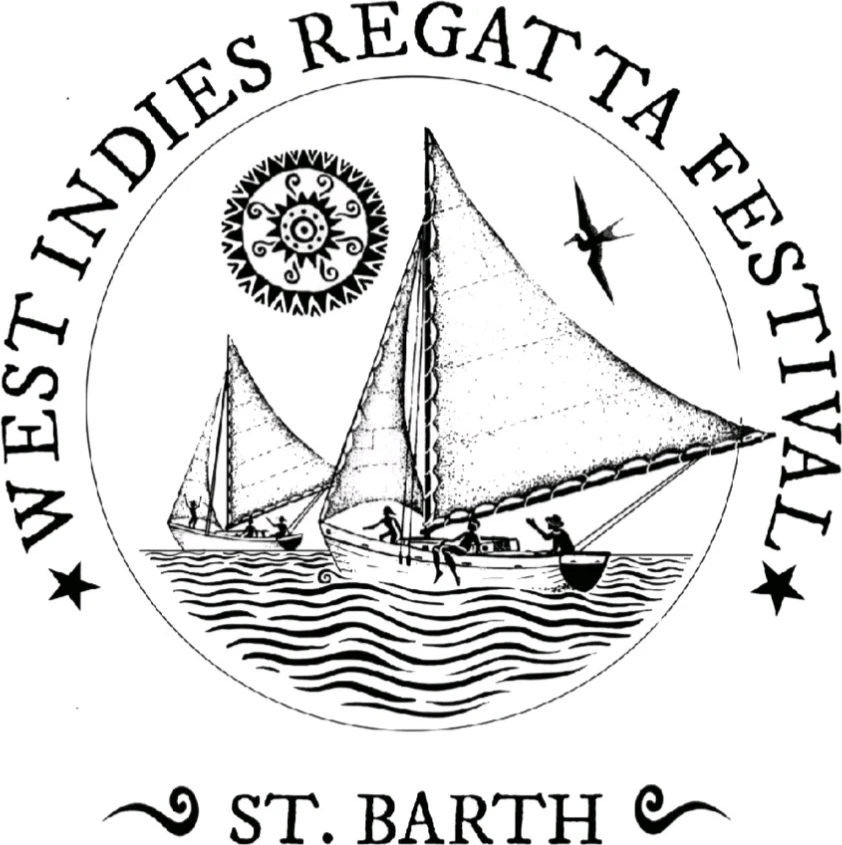
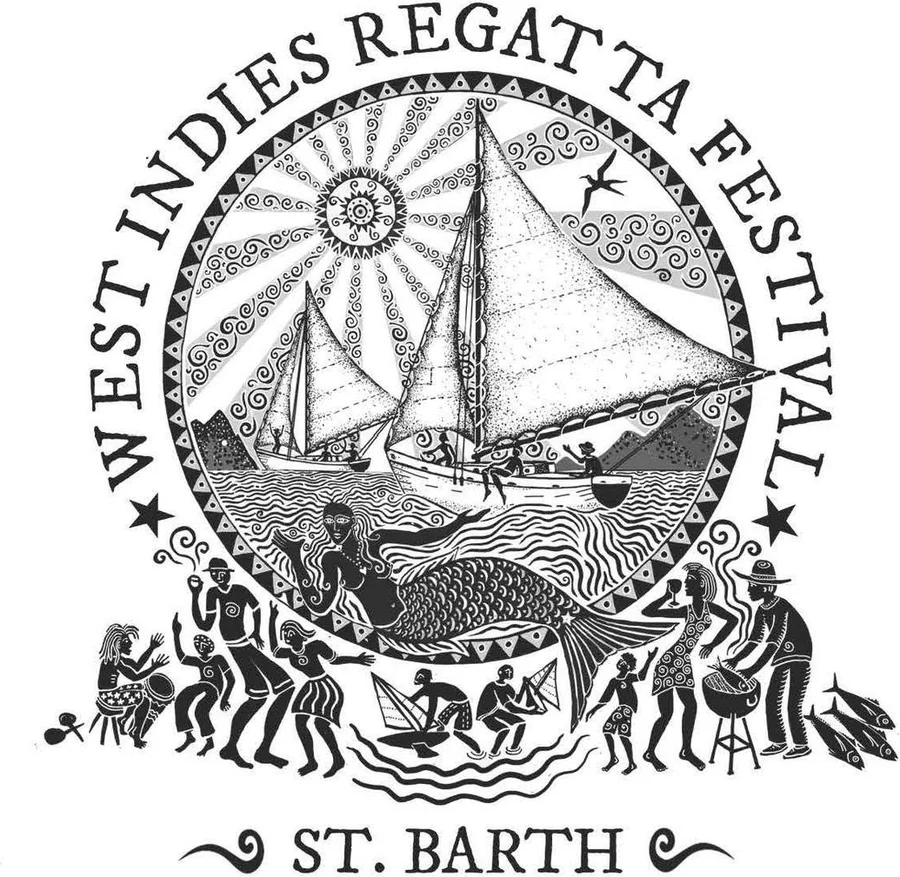
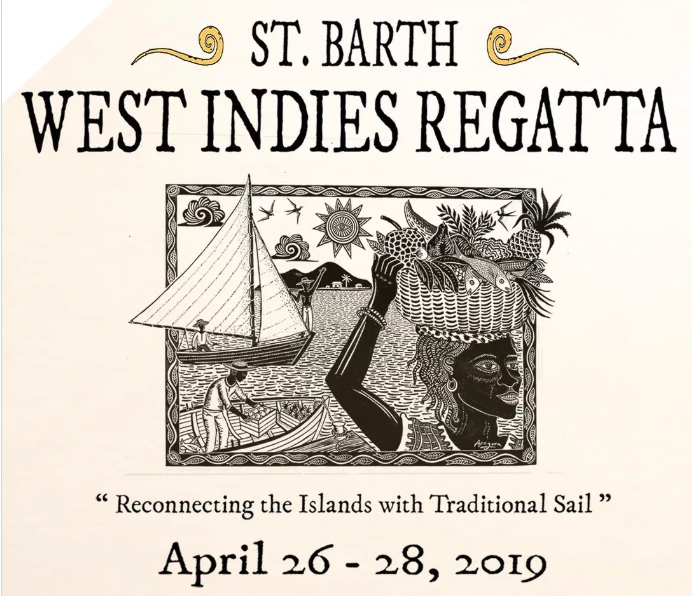
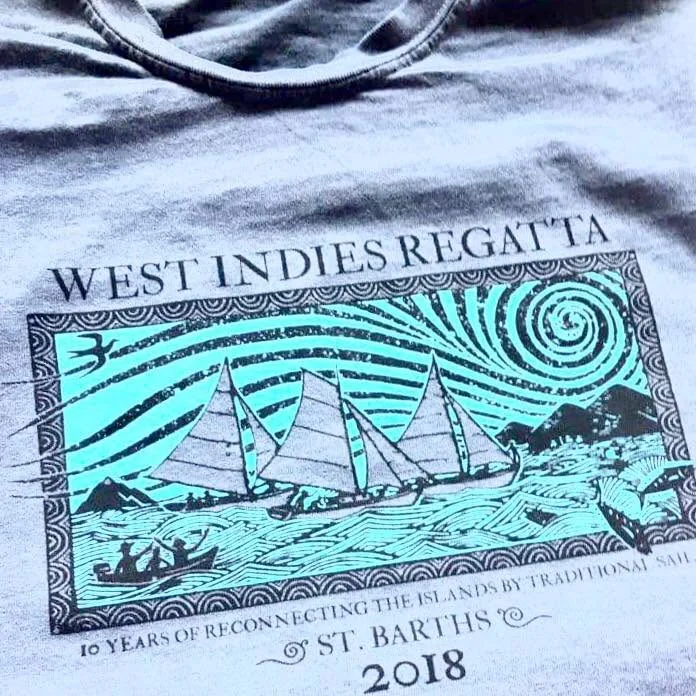
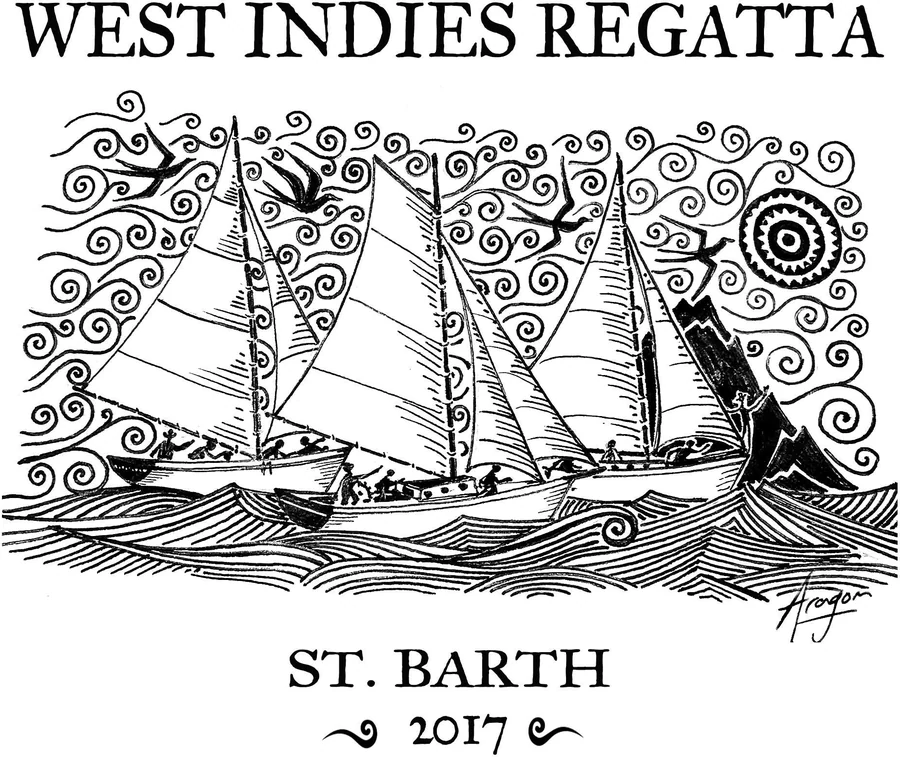
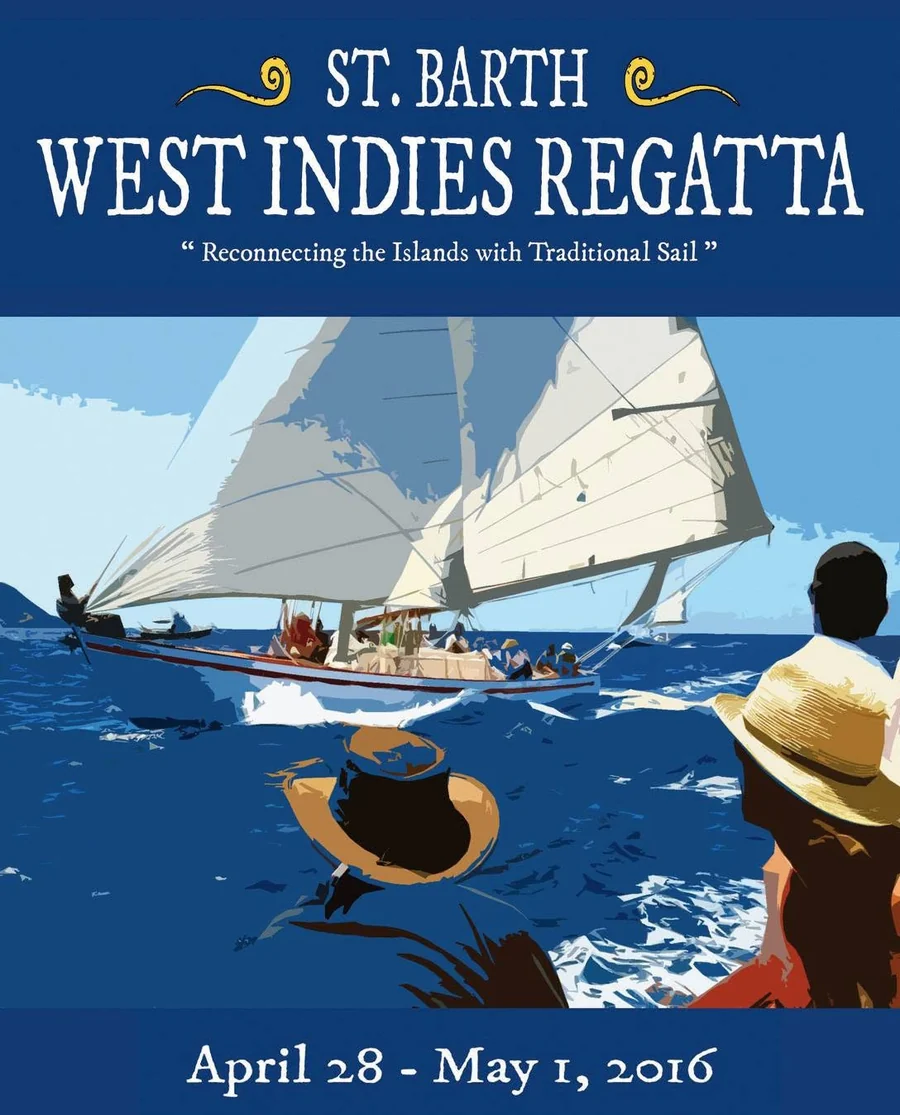
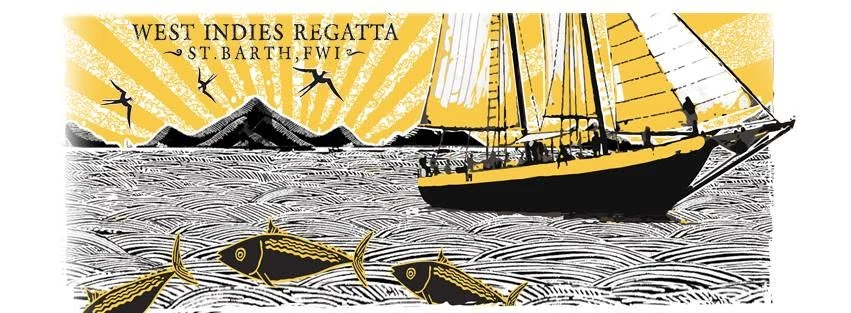
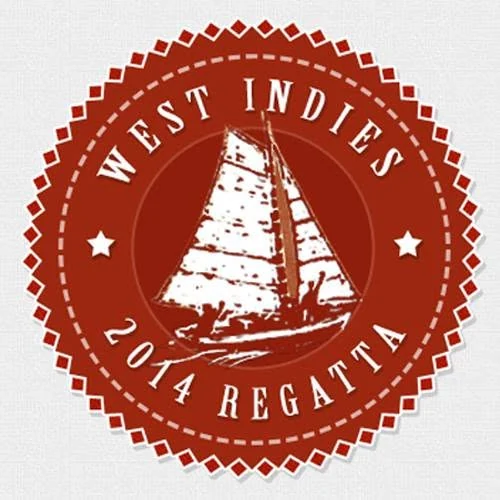
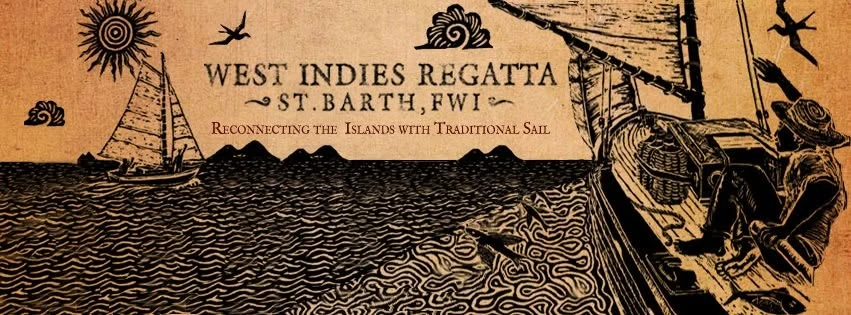
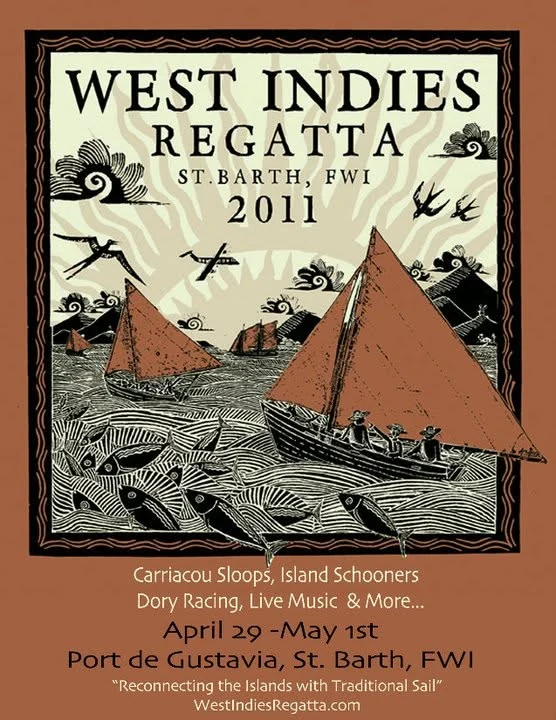
Every year, the West Indies Regatta Festival logo is created by the same hand. That of’Aragorn Dick-Read, sculptor and multimedia artist based in the British Virgin Islands — a man whose work and story are intertwined with what the festival seeks to defend.
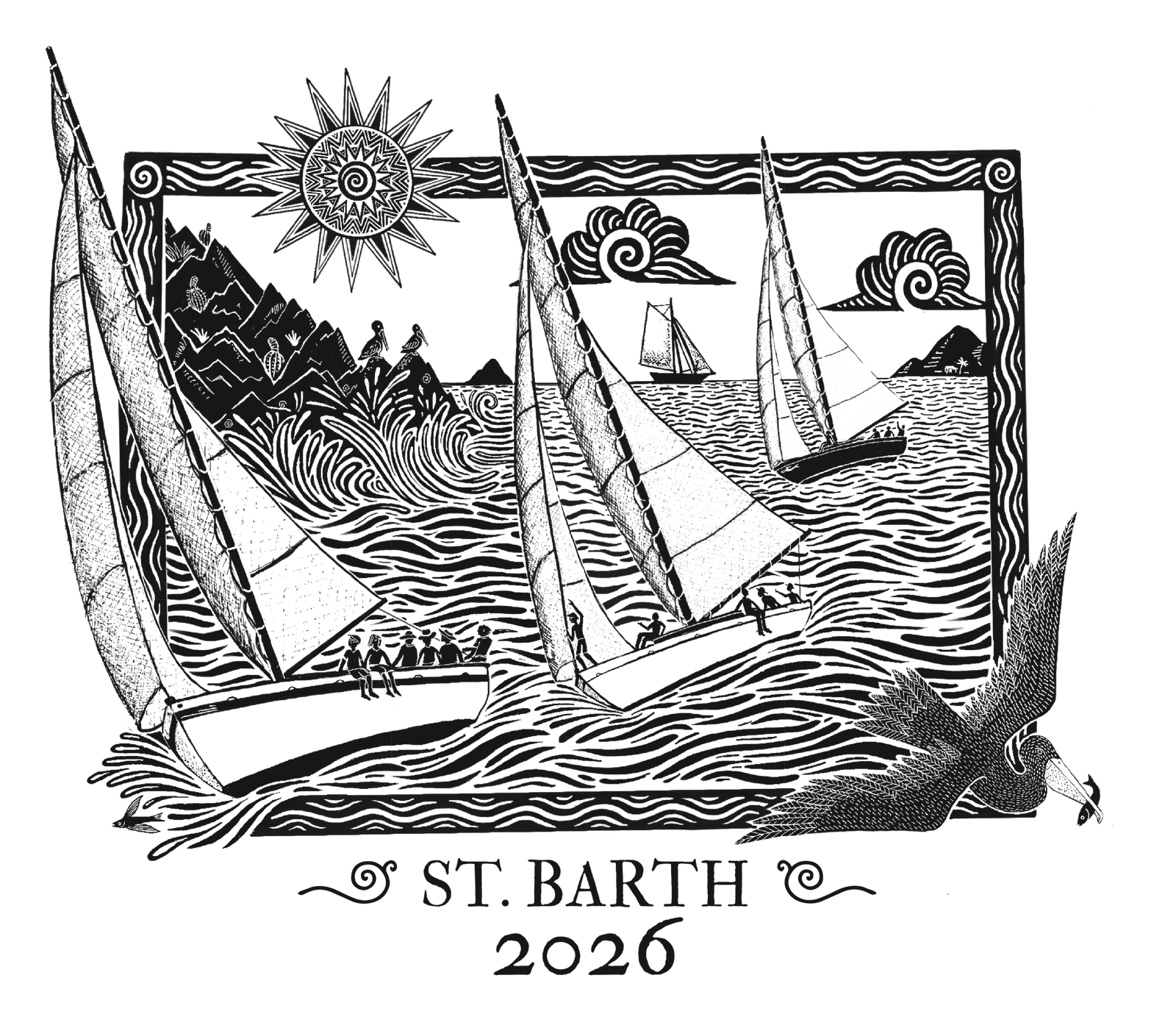
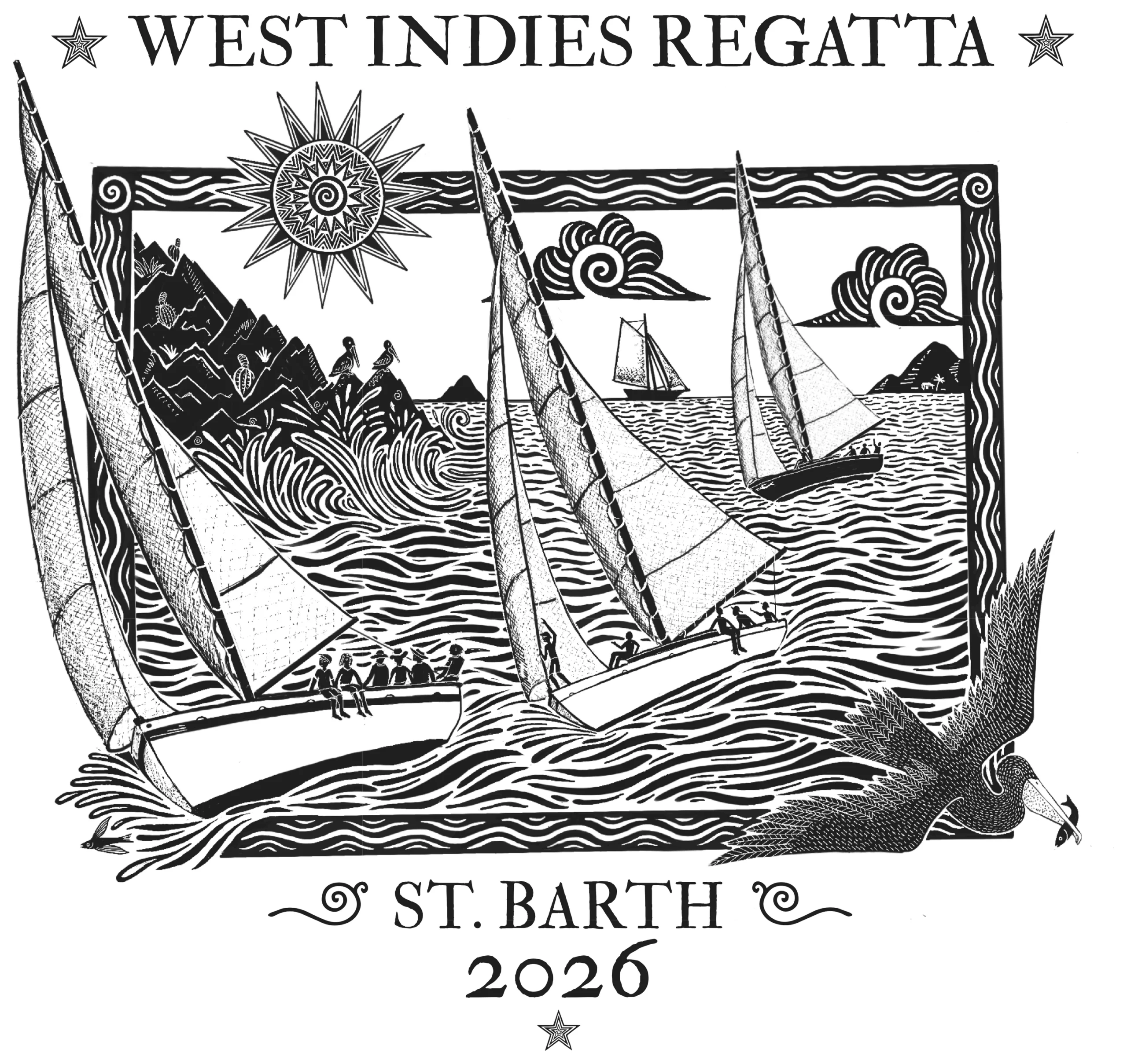
Click on the logo to zoom. Press Esc, click on the background, or use the Back button to return.
It's more than just a logo.
It's a true work of art!
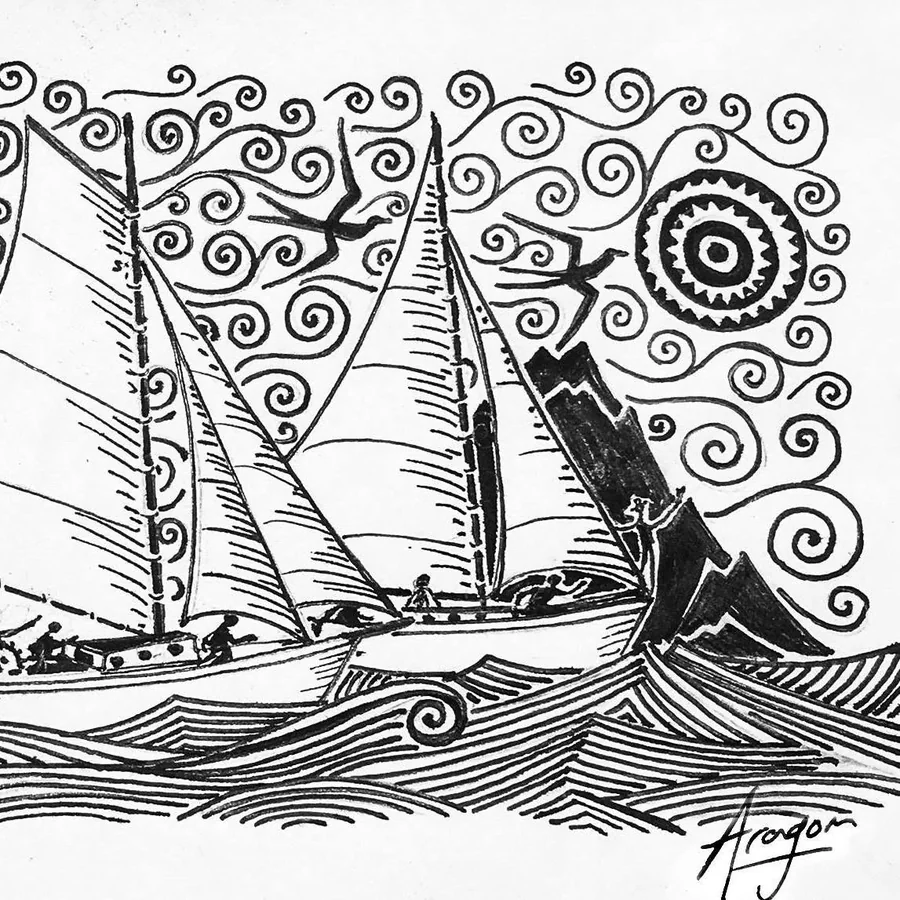
A monochrome black pencil stroke reveals a two-tone black and white work, where objects, characters and landscapes are not only drawn in black: a whole play on the absence of black gives rise to new details, from the rope that holds the sail to the cactus on the island, passing through the details of the clothes or the house in the background…
It depicts the West Indies Regatta sailing around a small islet… Did you recognize the boats? The easiest one being Navasana, with its sirens on the bow!
Did you appreciate the work on the framing? The dynamism of the boat emerging from it in a burst of spray, or the pelican escaping from a bygone era where it could no longer remain confined. You can almost hear its cry, telling you: "Like these boats, we are few in number, but we are still here!"«
Born on an island, educated in Europe, returned to the Caribbean
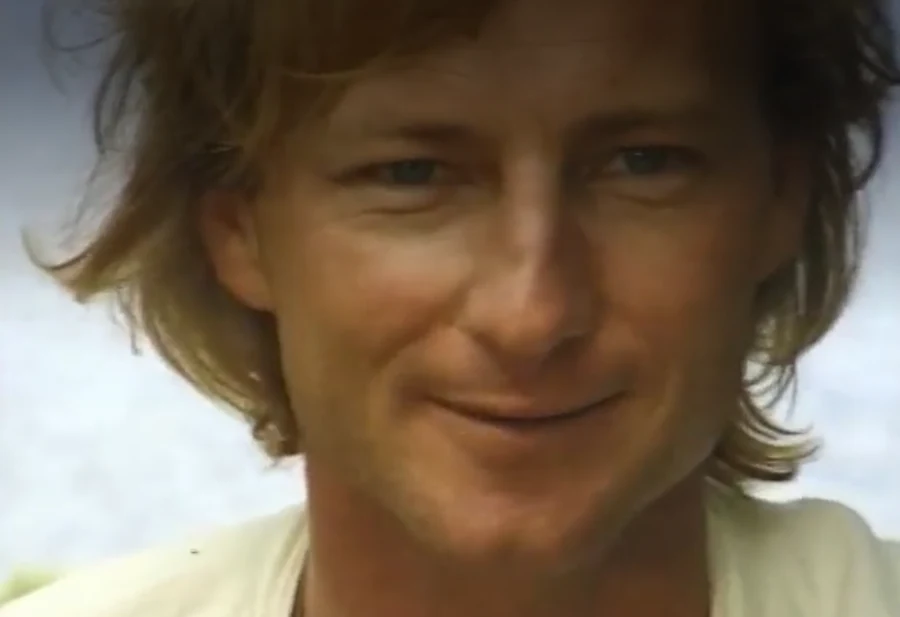
Aragorn Dick-Read was born in Tortola in 1966. He went to Europe to study pottery, engraving, design and metalwork, and earned a degree in art history focusing on tribal art and the 20th century. His travels then took him to Africa, Asia and the Americas, before he returned to settle where he was born.
He chooses metal, he says, for its permanence. His sculptures play with polished surfaces and patinas, cut-out silhouettes, and above all with light — even bringing fire into the work itself.
Gli Gli: the canoe that connected the islands to the Orinoco
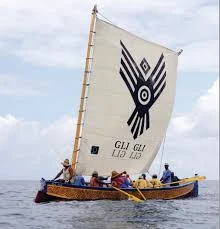
In 1995, young Kalinago people from Dominica conceived an idea: to find, by sailing, the Carib people who remained on the continent, in the Orinoco Delta. Aragorn joined forces with the Kalinago artist. Jacob Frederick to carry out the project.
The construction is managed by Etien Charles, known as «Chalo», the last master canoe builder in the Carib Territory, who is training twenty-one young people. The keel is carved from a gum tree—chosen for its sap—the ribs from white cedar. The canoe measures thirty-five feet, open, rigged according to the traditional model. It is christened Gli Gli.
Two years later, the crew sailed down the Lesser Antilles to Grenada, Trinidad, and Guyana, and then up the Pomeroon River to meet Carib and Arawak communities. The BBC made a film about it., Quest of the Carib Canoe. Back in the north, the canoe will be used to take the schoolchildren of Beef Island sailing.
In 2007, Gli Gli It makes a stopover in Saint-Barthélemy. Its story is making the rounds of the island — and it is one of the threads that will lead to the West Indies Regatta. Read the festival timeline.
May 2007: Gli Gli sails up the Leeward Islands arc
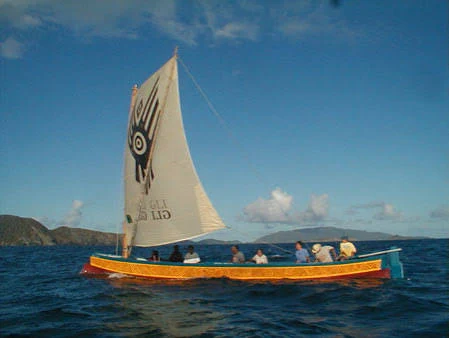
Ten years after their descent to the Orinoco, the crew sets sail again, this time heading north. May 6-26, 2007, Gli Gli leaves Antigua and travels up the Lesser Antilles: Nevis, Saint Kitts, Saint Barthélemy, Saint Maarten, Anguilla, Sombrero, then the Anegada Pass to Tortola. A dozen Kalinago boats from Dominica are on board, escorted by the Fiddlers Green, the support sailboat of Douglas "Doggy" Watson — the same one who, the following year, would steer the sloop Genesis from Antigua to the Virgin Islands with Alexis Andrews and Aragorn.
The bar is held by Etienne "Chalo" Charles, the master builder who had carved the hull twelve years earlier. Paulinus Frederick carries the group's message into schools and community halls; ; John Francis co-directs the project. Also on board: basket weavers, drummers, apprentice carpenters — the crew is a floating workshop as much as a crew.
The objective can be summed up in one sentence of the final report: to make "« the spirit of cultural resurgence that is gaining ground among the indigenous peoples of the Caribbean »In Saint Kitts, the crew paid their respects at Bloody River, where the last Kalinago people of the island were massacred by colonists in the 17th century.e century — and there discovers the victims' bones, exhumed and placed in boxes. In Anguilla, more than 1,500 people The canoe is waiting on Sandy Ground beach, and the crew descends into the cave of The Fountain, whose walls bear the entire Native American pantheon engraved. Chalo addresses the ancestors there:« We came to rescue you. »
Gustavia, May 13, 2007: The stopover that revealed a family connection
The crossing from Nevis was made downwind in a swell that twice nearly filled the canoe. Chalo had the sails reduced—the sprit wasn't removed, but the headboard was shortened by three feet on the bamboo, a maneuver never before attempted—and Gli Gli enters Gustavia in the late afternoon.
On the quayside, not hundreds of schoolchildren like in Basseterre, but a welcoming committee which says a lot about the island: Lou Lou and Jenny Magras, Daniel Blanchard, former mayor, then head of the UNESCO Club and host of the expedition, Raymond Magras, another former mayor, the current mayor Bruno Magras and his deputy Yves Gréaux. The first connection is forged even before introductions: the Kalinago and the Saint-Barths speak the same French Creole. The UNESCO Club accommodates the crew at the municipal guesthouse and lends them a minibus.
The second link was unexpected. Aragorn recounts it thus in the expedition's report:
Almost nothing remains of Carib culture in St. Barthélemy—except, as we discovered, that the island's traditional fishing boats were once dugout canoes with sails. For an island without trees, it was an odd choice of hull. Daniel and his cousin Édouard told us that the canoes were bought in Guadeloupe or Dominica, then converted into fishing boats in St. Barth by adding planking and frames.
And the coincidence is staggering: even before knowing that Gli Gli would stop over at their place, Daniel Blanchard and his cousin Edward had undertaken to rebuild one of these boats. They had ordered an eighteen-foot dugout canoe from Prosper Paris, in Dominica's Carib Territory — who had entrusted the work to his father-in-law. That is to say, to Chalo. The hull, carved by him, had already arrived in Saint Barthélemy and was being worked on in Édouard's workshop when the canoe entered Gustavia. The two Carib master builders and their apprentice sons thus found their own work, hundreds of miles north of where it had been carved.
The next day, the crew goes up "in wood" to Deep Water cutting members of poywe, the local pear tree.« The moon was at a good time and the chainsaw was working. »" notes Aragorn. The poywe of Saint-Barth is small compared to that of Dominica, but the drought of the island makes it grow slowly: a hard wood, excellent for frames.
There remains the third link, the lightest and perhaps the most telling. During a beach picnic at Small Cul-de-Sac, The Kalinago and their guests play old Creole music together: the French accordion, drums and the shak-shak Caribbeans, and the subtext of Creole songs on top of that.« You would have sworn that Gli Gli's band and our St. Barth's hosts had been playing together for years. »"Before leaving, the crew takes their guests out for a canoe trip.".
It is this stopover — a boat hollowed out in Dominica and finished in Saint-Barth, a common language, an accordion and drums on the same beach — that makes Aragorn Dick-Read more than just an illustrator for the West Indies Regatta. He had already connected the two islands by the hull of a boat before designing its logo.
Watch the movie
Quest of the Carib Canoe — «The Quest for the Canoe 2000». Here is the presentation given by the festival program during its screening:
Set off with Aragorn to meet the last Kalinagos of Dominica, to follow a dream: to build a huge canoe as their ancestors would have done five hundred years ago, and to travel with him the ancestral migratory sea routes through the Antilles.
The documentary can be viewed right here:
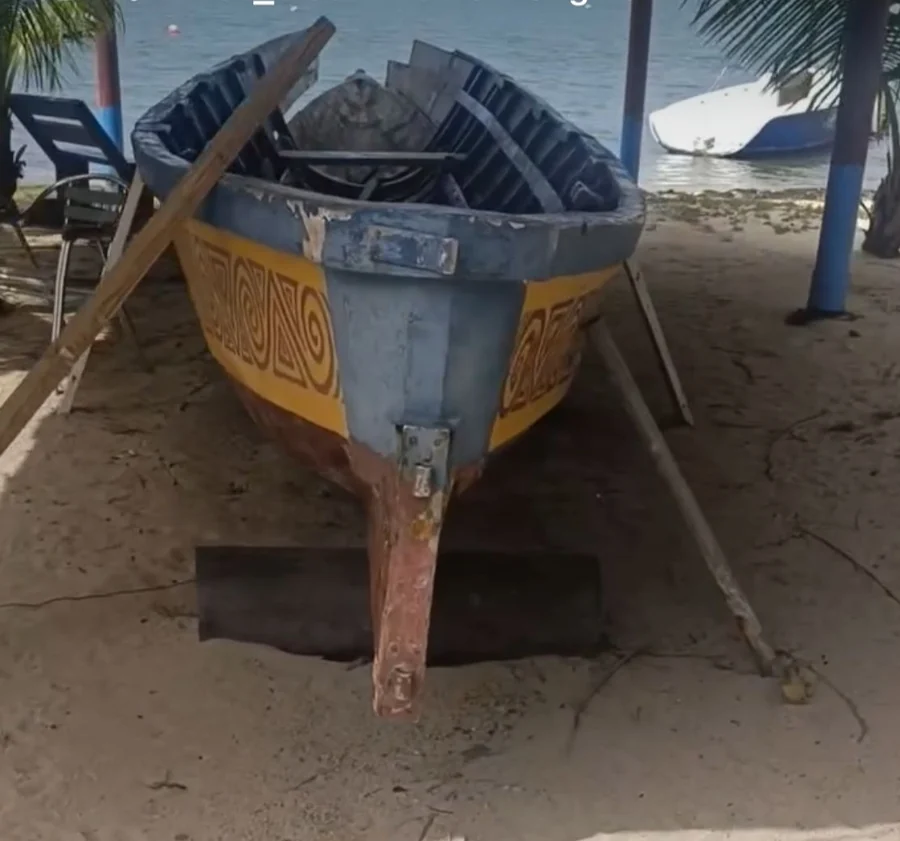
Gli Gli needs repairing
A hurricane damaged the front of the canoe. Gli Gli is now on the ground, resting on its crutches, and awaiting repair work.
During the film's screening in Saint-Barthélemy in 2026, Aragorn explained that the canoe had connected all the islands, from the Amazon to the British Virgin Islands — but that he still needed to go as far as Cuba. His plan is therefore to restore it and complete this journey.
Aragorn's sculptures — Metal and fire
His fire sculptures—spheres, pyramids, openwork cubes—have become his signature. The metal is cut with patterns that are only revealed once flames are lit inside: the light passes through the material and projects the design all around. At Trellis Bay, these fireballs are placed in the water and set alight at each full moon.
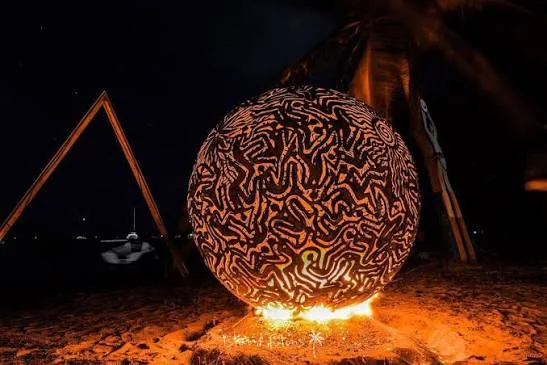
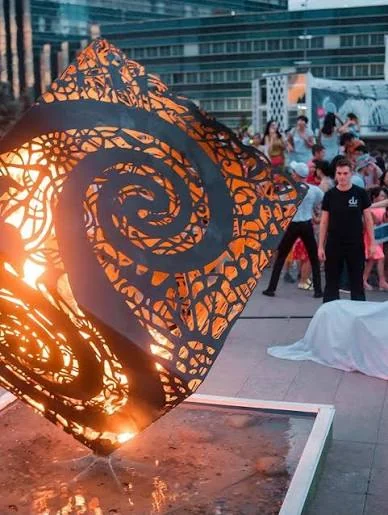
It all started with a ball washed up on the beach. Each sculpture is unique and handcrafted from a steel sphere, ranging from one to five feet in diameter—thirty centimeters to one and a half meters. He carves entire scenes into it, then feeds them with wood: the image changes throughout the combustion, from the initial blaze to embers. Once he has mastered the sphere, he creates... cubes and pyramids.
What he cuts out of the steel are "human figures, animals, symbols, and motifs." And the work remains unfinished as long as it is cold:« The images only take on their full meaning once the fire is lit inside: the drawings stand out against the flames, come to life and hold the gaze. »
In Trellis Bay, the sculptures are displayed in front of the workshop, on the beach. each full moon and during the Trellis Bay New Year's Festival, He installs them on supports in the sea, just beyond the shore, for the public to see; on New Year's Eve, fountains and fireworks are added. His fire sculptures are now featured in private collections and galleries worldwide.
The process eventually spread: Aragorn was invited to 12e Changchun International Sculpture Symposium, in China, where he created a fireball for the city's sculpture park three meters — twice as large as anything he had done before — amidst works by more than four hundred artists from one hundred and thirty countries. He carried the flag of the British Virgin Islands. A book has since been devoted to these fireballs.
His work has been shown in London, St Martin-in-the-Fields, New York, at the Cast Iron Gallery, and throughout the Caribbean. He co-founded the Caribbean Artisan Network, which connects local artisans.
A workshop, a floating shop, a farm
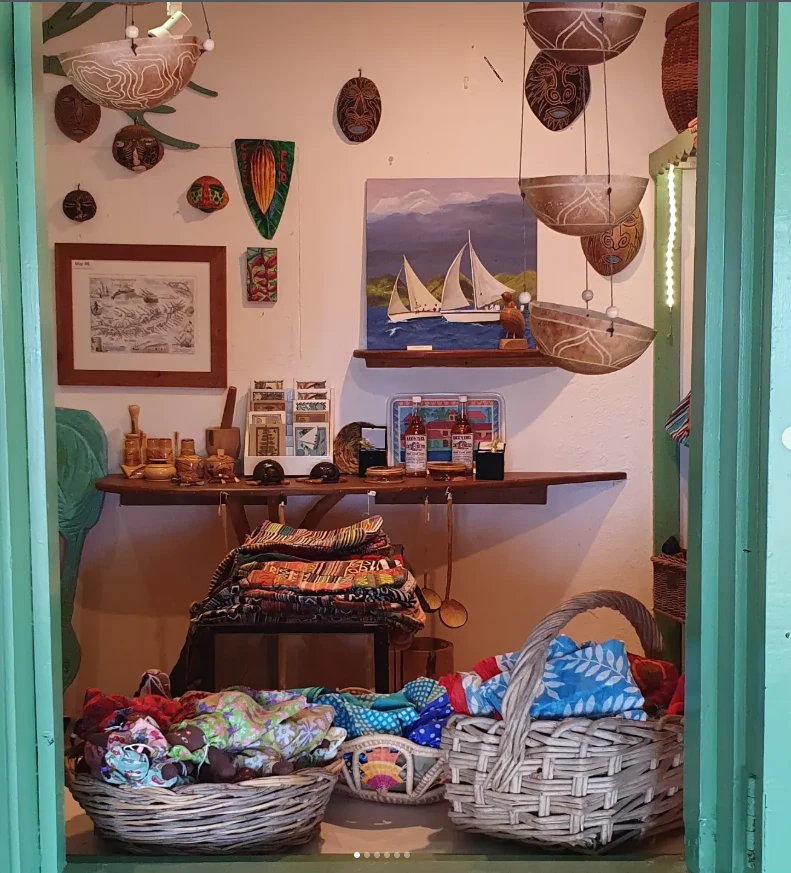
The sculpture is just one of Aragorn Dick-Read's hands. It's a journey into Haiti, in 1987, which gave birth to the silhouettes cut out in copper and steel — turquoise patinas on polished copper, blackened steel worked in fire.
But since 1985, it is above all his hand-printed t-shirts which left the islands in suitcases: an engraved design, transferred using silkscreen printing, hand-printed on heavy cotton — and the same twelve motifs exist as prints on organic cotton or hemp paper. Two ceramicists also work at the Trellis Bay workshop, Debbie Entwistle And Liz Crowley, who give lessons; the fireballs ceramics are thrown and then fired in raku, the Japanese technique of the 17the century, cooled in shredded paper which gives them their metallic sheen.
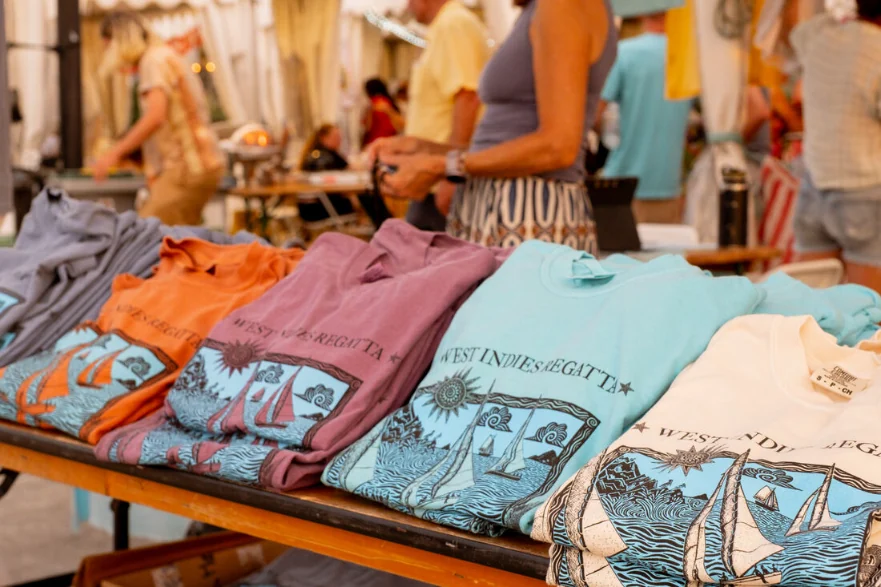
Perhaps the most Caribbean aspect of all this is its floating shop Every morning, Aragorn loads a boat with spices, fresh bread, local vegetables, T-shirts, and handicrafts, and shuttles between Trellis Bay and Marina Cay. The vegetables come from Good Moon Farm, his organic farm. On land, the shop presents itself as the only one of its kind in the British Virgin Islands: it sells only Caribbean items — baskets, bamboo masks, calabashes, drums, larimar, hats, pottery.
His work has been exhibited in London (St Martin-in-the-Fields, Smiths Gallery in Covent Garden), New York (Cast Iron Gallery, Soho), Antigua (Harmony Hall), Saint-Barthélemy and Tortola.
Trellis Bay: a studio, a pottery workshop, a village
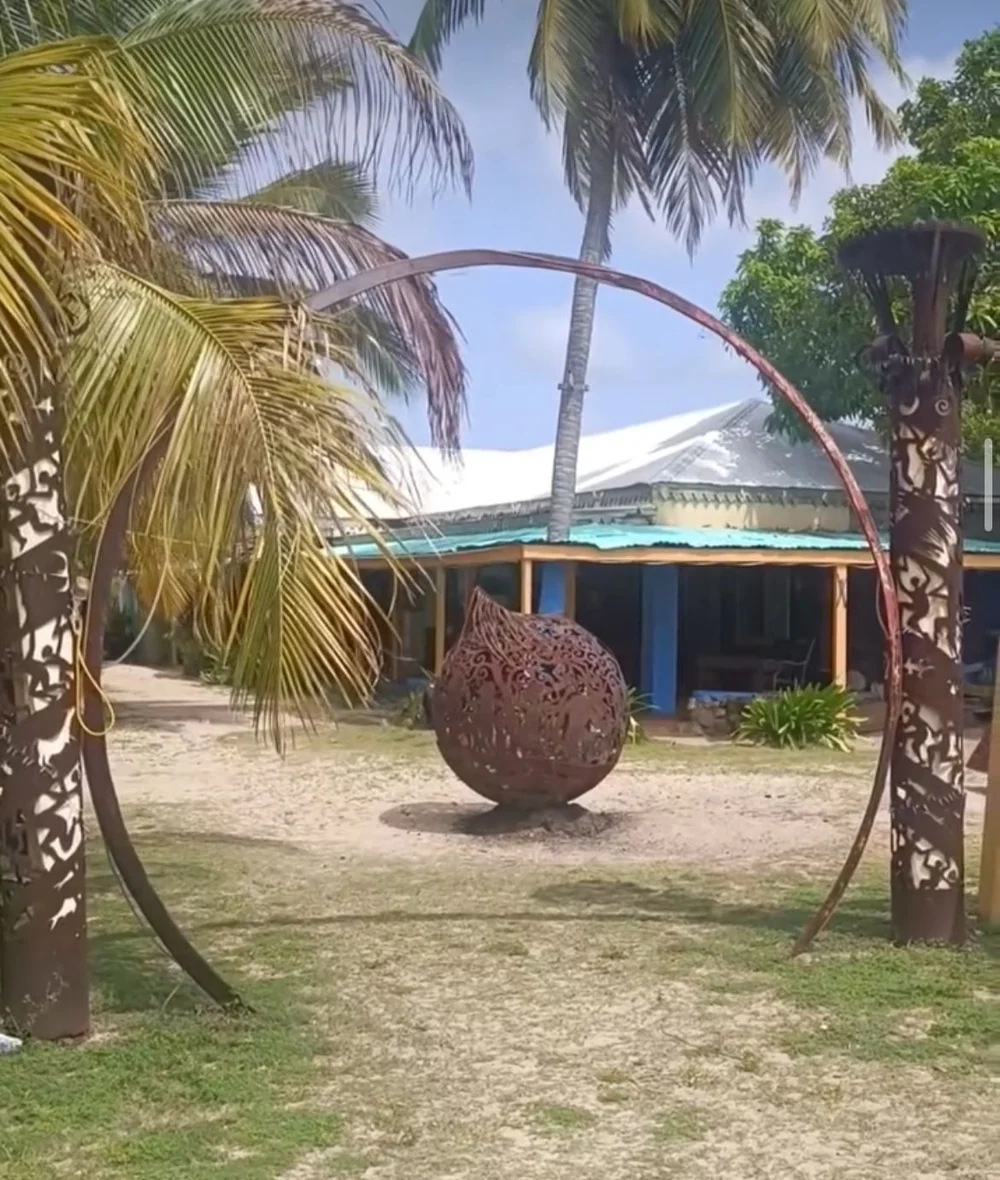
Aragorn lives and works in Trellis Bay, on Beef Island, with his wife Federica Feliziani—also a painter—and their two sons. On site: his gallery, a pottery workshop, and an art center that exhibits Caribbean artisans and offers classes. It's a place well-known to passing sailors.
To search, to write, to transmit
For years, Aragorn Dick-Read has been conducting in-depth research on Caribbean crafts: a photographic book and a documentary, state by state, from Belize to Suriname, on pre-Columbian, African, and European traditions and how they have intertwined. The aim is not merely aesthetic. It argues that the region's most vibrant artisans are almost always found on its margins—descendants of Taíno, Carib, Maroon, Rastafarian, elders, and prisoners—and that craftsmanship gives them an independence that the labor market does not offer. The book is to include visual demonstrations of the craftsmanship,« for those who cannot read »and serve as a textbook in schools.
Same intention behind the Caribbean Artisan Network, which he co-founded, and behind the Trellis Bay workshop, where skills are taught to anyone who comes along.
To see him, to follow him
- Aragorn's Studio — Trellis Bay, Beef Island, Tortola VG1110, British Virgin Islands — Open in Google Maps
- artist's Instagram — @aragornbvi
- Instagram of the studio — @aragornsstudio
- Sites — aragornbvi.com · aragornsstudio.com
Sources
- Biography and presentation of the artist — aragornsstudio.com/Aragorn.htm
- Gli Gli Leeward Island Expedition, final report, May 2007 — report in PDF format (The above quotes are translated from it)
- Daily logbook of the expedition — aragornsstudio.com/gligli/updates.htm
- Objectives and crew of the expedition — aragornsstudio.com/gligli/objectives.htm
- Fire sculptures — aragornsstudio.com/fire.htm And aragornbvi.com (Changchun's fireball)
- The book project on Caribbean crafts — aragornsstudio.com/Projects.htm
Photographs of his works belong to the artist. We await his permission to publish them here.