
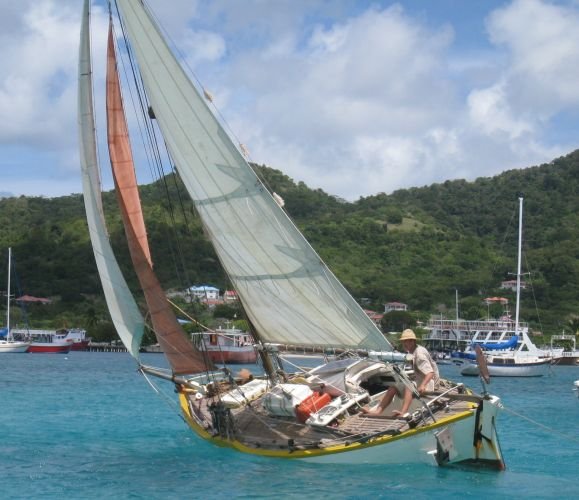
- Boat type — a gaff-rigged cutter, pointed stern like the bow, on the lines of the Bequia whaleboats
- Launching — December 21, 1965, on Admiralty Bay beach, in Bequia
- Length — 29 feet 9 inches overall, or approximately 9.1 m — 25 feet 9 inches on deck, 22 feet at the waterline
- Beam and draft — 8 feet 9 inches wide, approximately 2.7 m — 4 feet 6 inches draft, approximately 1.4 m
- Shift — approximately 5 tonnes
- Built by — Klaus Alvermann, German architect and sailor, assisted by the Bequian shipwright Loren Dewar
- Deeds of arms — two circumnavigations of the world. First boat built in Bequia to complete a circumnavigation
- In Saint-Barthélemy — present at the very first West Indies Regatta, in 2009, among the eight boats that entered the port of Gustavia
- Today — Nova Scotia, Canada. Planking reattached and boat relaunched in 2025
A young German man on Admiralty Bay beach
In the early 1960s, a young German architect and sailor settled in Bequia, in the Grenadines of Saint Vincent. Klaus Alvermann designed houses to live in—he even designed the island's pizzeria—and watched the shipwrights working on the sands of Admiralty Bay. What Klaus Alvermann really observed were the Bequian whaleboats: hulls pointed at both ends, designed to be rowed and sailed through the choppy waters of the channel.
From these lines, Klaus Alvermann wanted to make a high-seas boat. No plans on paper, not a single electric machine: the hull was shaped by eye and by hand, directly on the beach, with the help of a shipwright from the island, Loren Dewar, whose grandchildren still build whaleboats in Bequia today.
December 21, 1965: the round belly descends to the sea
During the months of construction, those in the know who frequented the beach had a comment about the hull taking shape: it was round. Too round, squat, pot-bellied. The nickname stuck and became the boat's name. Plumbelly, with its rounded belly, was launched on December 21, 1965.
Five tons of wood to withstand the South Seas
Beneath its rounded shape, the structure is excessively oversized. The frames are made of solid cedar, two and a half inches thick, spaced only eleven inches apart. No plank of the hull is less than an inch thick. Below the waterline, Klaus Alvermann uses silver balli, a very dense hardwood from Guyana, renowned for its resistance to shipworms and rot. The deck and upper decks are made of heavy pine. For 25 feet on deck, the displacement reaches five tons.
A bucket, six jerrycans, and no engine
The interior, however, is a testament to the principles behind the design. There's no standing room in Plumbelly; it's all seating. There's no freshwater tank, only six five-gallon jerrycans. The toilet is a bucket. The boat is built without an engine, and the only comforts on deck are a long tiller, a rudimentary self-steering gear with a flap, and a companionway enclosed by a simple canvas cover. An 8-horsepower outboard bracket would only be added much later, mounted on the stern.
December 1968: Heading west
Klaus Alvermann initially spent a few years sailing in the Caribbean. Then, in December 1968, Plumbelly left the Caribbean for the Panama Canal and the Pacific Ocean. The poet and columnist Richard Dey, who dedicated a profile to the boat published in The Spray magazine in 1980, summed up the voyage in a single sentence: a boat without an engine circumnavigating the globe, from Bequia to Bequia, from 1970 to 1976, its owner stopping from time to time to work as an architect and pay for the journey. Klaus Alvermann kept Plumbelly for about twenty years and sailed her around the world twice.
One week of this journey has gone down in history: 1,120 miles in seven days, or 160 miles per day on average, for a boat of 22 feet at the waterline.
Tahiti, Moitessier, and a kid who decides to build his own boat
In the Pacific of the 1970s, Bequia's small cutter crossed paths with the elite of the sailing world. In Tahiti, Klaus Alvermann met Bernard Moitessier, and it was under his guidance that he built his self-steering gear. In New Zealand, a nineteen-year-old American came aboard and left with a fixed idea. Reid Stowe, who would later break the record for the longest non-stop voyage at sea, recounts it frankly: Plumbelly had an enormous influence on him—its hardwood, its curves, its grace—and it was there that he decided to build his own boat.
Fifteen long seconds, north of New Zealand
In December 1971, Klaus Alvermann was asleep in his bunk when a crosswind toppled Plumbelly north of New Zealand. "It lasted fifteen seconds, I counted them, and they were long seconds," he would later recount. The boat righted itself and continued on its way, with minimal damage. The silver balli and the two-and-a-half-inch frames had done their job.
The first boat from Bequia to complete a circumnavigation of the world
Plumbelly remains in the maritime history of the Grenadines as the first boat built in Bequia to have circumnavigated the globe. In 1975, when the Suez Canal reopened after eight years of closure, the small cutter was among the very first pleasure craft to transit it. Klaus Alvermann died on January 30, 2007, in Hamburg.
After Klaus: Maine, and a carpenter returning to sea
The boat then passed into the hands of shipwrights in Maine. Daniel Bennett kept it for half a dozen years and sailed it to Bermuda—with a broken boom, broken gaff, and broken bowsprit upon arrival, which speaks volumes about how Plumbelly was sailed. Around 2003, the boat was acquired by another shipwright, Patrick DiLalla.
In October 2004, Patrick DiLalla set sail alone from Maine to Bermuda: ten days at sea and two berths in a northeasterly gale right in the middle of the Gulf Stream. He described the impact as being like a skier hitting a tree stump in the powder. Twenty people were waiting for him on the dock upon arrival. By the spring of 2009, Plumbelly had completed its twenty-seventh and twenty-eighth transatlantic crossings, with Portugal, Morocco, the Canary Islands, and Senegal on its itinerary.
2009: Gustavia, the very first meeting
It was in that year that Plumbelly entered the port of Gustavia. The boat was one of eight to participate in the very first West Indies Regatta, alongside Genesis, from Ocean Nomad — today Navasana -, of Tradition, of Sweetheart, of Good Expectation, of Summer Cloud and of the schooner Alexander Hamilton. At 29 feet overall, Plumbelly is the smallest boat in the census — and the only one from a Bequia shipyard.
The 2009 season also marked Plumbelly's last known appearance in the Caribbean. No other sightings have been found since. Patrick DiLalla brought the boat back to Maine and put it up for sale.
The Far North: Nova Scotia, and fifteen years of doubt
In 2010, Plumbelly was shipped to the Maritime provinces of Canada. On August 28, 2011, Alison Welch publicly announced that she and her partner Chris had become the new owners, with a clear plan: "We hope to bring her back home to Bequia for her fiftieth birthday in 2015." The return trip never happened.
In 2013, the boat was again for sale in Nova Scotia. A reader who wanted to buy it back to Bequia and entrust it to the island's youth missed the deal by a day: another buyer had signed the day before.
The following years were years of decline. By the autumn of 2024, Plumbelly was described as moored in Shining Waters Marina, riggless, with cotton hanging from open seams, peeling paint, and a rusty keel ballast. The word used by those who saw it was unequivocal: this boat needed to be rescued.
September 2025: Plumbelly returns to regatta racing
And that's exactly what happened. Shipwright Ollie Cote undertook the complete re-planking, and on September 21, 2025, Plumbelly raced in the Lunenburg September Classic, Nova Scotia's traditional boat regatta. The photo released that day shows the cutter under mainsail, jib, and staysail, heeled over, with three people in the cockpit. Daniel Bennett, who had owned her forty years earlier, commented in one sentence: "What a pleasure to know Plumbelly is re-planked and back in the water."«
A month later, the boat was hauled out for the winter at the LaHave River Yacht Club, near Bridgewater, Nova Scotia. Sixty years after Admiralty Bay beach, two circumnavigations and twenty-eight Atlantic crossings, Plumbelly is still sailing.
Sources
- Charles J. Doane, The Legend of Plumbelly, Wave Train, December 30, 2009 — the construction, dimensions, materials, world tours, the 1971 capsize, the successive owners. The comments on the article, from 2011 to 2025, continue the story in Nova Scotia.
- Richard Dey, Writing On The Sea: An Historical Overview of Yachting, Caribbean Compass — refers to his portrait «Spontaneity and the Single-Hander: Plumbelly of Bequia Around the World», which appeared in The Spray magazine in 1980, and in an abridged version in Yachting in March 1978. This is the source for the round-the-world trip from Bequia to Bequia, from 1970 to 1976.
- Charles J. Doane, Me, the Boat and a Guy Named Bob, Wave Train, January 20, 2022 — the carpenter Loren Dewar, and the anecdote of Bob Dylan being dropped off aboard Plumbelly to avoid the crowds of Bequia.
- Charles J. Doane, Comprehending Reid Stowe: Early Voyages & The Moitessier Factor, Wave Train, April 20, 2010 — Bernard Moitessier in Tahiti, and the meeting with Reid Stowe in New Zealand.
- A Home, Bequia Stories — Klaus Alvermann in Bequia, architect, and the island pizzeria he designed.
- West Indies Regatta Showcases Traditional Sailboats, All At Sea, July 1, 2009 — the eight boats of the first edition, and Plumbelly described as the smallest of the fleet.
- Plumbelly of Bequia, YBW forum — the 2009 sale, the move to Nova Scotia and the failed 2013 sale.
- Facebook post by Daniel Bennett sharing Ollie Cote, September 21, 2025 — the relaunch and the Lunenburg regatta.
Contact — Plumbelly
- The definitive portrait: The Legend of Plumbelly, by Charles J. Doane.
- Richard Dey's portrait of Klaus Alvermann, published in The Spray in 1980: Writing On The Sea, Caribbean Compass.
- Loren Dewar and Bequia in the 1960s: Me, the Boat and a Guy Named Bob.
- Do you sail on Plumbelly or have photos of the boat? Write to us using the form below — this form will be completed.
Complete this form
Do you know this boat, its history, its voyages, or an official page where you can contact it? Help us enrich this information: your message goes directly to us.
Your message is forwarded by email to the site team; it is not stored in the site's database. The email address you provide is used solely to reply to you. You can request access to, correction of, or deletion of this information by writing to the site team.